
It’s 3:30 PM on a Thursday and Your WordPress Site Just Went Down: Website Security in 2026
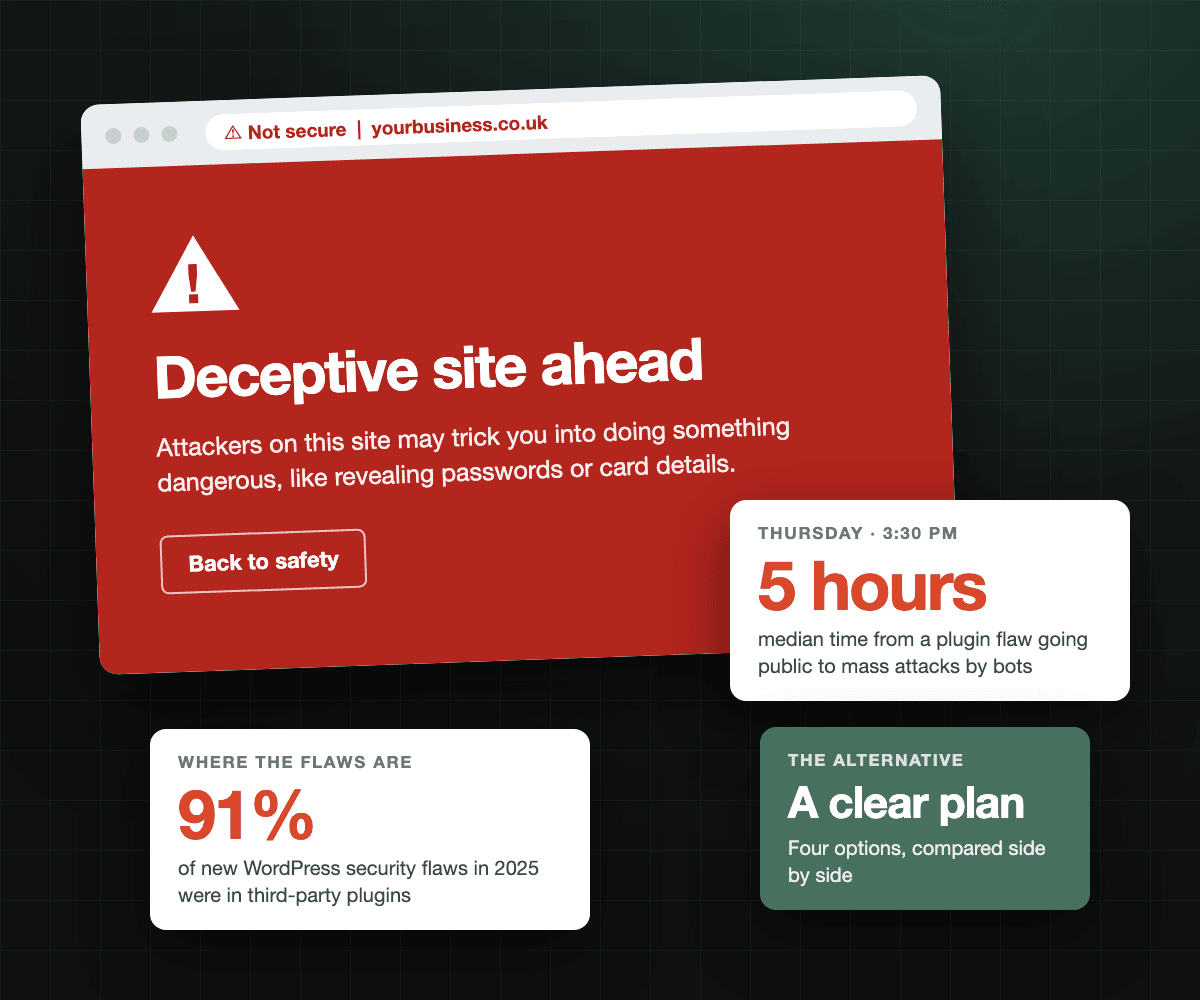
It is 3:30 PM on a Thursday. Your day is already full, and then your website goes down. Or a customer messages to say your site is redirecting to spam. Or Google has put a full-screen “Deceptive site ahead” warning across your homepage.
How do you react in that moment? Is anyone on standby? Do you have clean backups, access credentials and a recovery plan, or are you scrambling while enquiries stop and leadership asks what is happening?
And here is the uncomfortable question: who is actually responsible if the website goes down? If the honest answer is “nobody” or “I’m not sure”, ask it another way. If it went down tomorrow afternoon, who would people in the business call first? That person is carrying the risk today, whether or not it is in their job description.
Why the old rules no longer apply
Attackers no longer pick their targets. Automated bots scan every website for known weaknesses around the clock, so no business is too small or too quiet to be hit. The numbers for WordPress in particular have moved sharply:
91% of new WordPress security flaws found in 2025 were in third-party plugins, not WordPress itself.
11,334 new WordPress security flaws were found in 2025, up 42% on 2024.
For the most heavily exploited plugin flaws, the first attacks begin a median of 5 hours after the flaw is made public. A monthly update cycle can leave up to a 29-day exposure gap.
46% of plugin flaws had no fix available when they were made public.
87.8% of WordPress-specific exploits get past standard hosting firewalls, because bots go straight for the plugins.
On top of that, two major waves of critical PHP flaws were disclosed in October and November 2026. Enterprise managed hosts patch these automatically; budget hosting often leaves the server exposed unless someone actively maintains it.
This is escalating, not standing still
It is tempting to think “it has never mattered to us before”. What has changed is both the volume and the speed. And the way attacks arrive has changed too.
In April 2026, a buyer who had acquired a portfolio of 31 WordPress plugins was found to have hidden a backdoor in a routine-looking update; WordPress.org closed all 31 in a single day. In October 2026, official Rank Math PRO downloads and automatic updates carried a hidden backdoor for about 11 hours. The sites affected did nothing wrong. They ran well-known plugins and installed updates as advised.
That is why “it is a trusted plugin with thousands of installs” no longer reassures. Popularity makes a bigger prize, ownership can change quietly, and updates are now one of the ways malware arrives. Fewer plugins, and fewer outside vendors, means less risk.
What a breach looks like, even without online payments
Your website goes offline. Pages are wiped, defaced or locked, often out of hours when nobody is watching.
“Book Now” links are quietly diverted. Booking and enquiry buttons are redirected to fake payment pages styled like yours. Customers pay criminals, then blame your brand.
Details are captured as customers type. Hidden code on your forms copies names, emails and card details in real time.
Google blacklists your domain. Visitors see a full-screen red warning, and search traffic disappears until the site is cleaned and reviewed.
The repair is rarely the biggest cost. Lost revenue, lost customer trust and emergency call-out rates add up fast, and if customer data is exposed you may need to report it to the ICO within 72 hours.
“Wait and see” is a choice, with a price
Doing nothing is a genuine option, and you may be fine for some time. But you would be accepting timing you do not control, clean-up paid at emergency rates rather than a planned fee, downtime and lost enquiries, and possible search and reputation damage. If you do decide to wait, keep a recent off-site backup and know exactly who you would call.
Preparing now is a fraction of the cost of an emergency breach. You do not need panic. You need a clear plan before anything goes wrong.
Your four options, compared calmly
No website platform is 100% immune. The right setup reduces the number of ways in. These are starting prices, not quotes.
Option 1: One-off clean-up, then fix as and when
A one-off tidy-up and hardening that removes unused plugins, blocks spam entry points and applies updates. No ongoing plan. Risk: high, because nobody monitors the site day to day. From £200 + VAT (from $250 in the US). Cheapest upfront, usually the most expensive over time.
Option 2: Managed WordPress hosting and plugin care
We move your site to an enterprise managed WordPress host that patches server-level PHP flaws automatically, and we handle plugin updates and backups. Risk: moderate to high; the server is covered but plugin flaws remain. £250–£350 + VAT per month ($300–$450 per month in the US). Setup is quoted once we have reviewed your site.
Option 3: Custom zero-plugin WordPress
Managed hosting, with forms, integrations and other features built directly into your theme so you no longer rely on plugin vendors. Risk: low to moderate; WordPress itself and PHP still need maintaining. The build is quoted once we have reviewed your site, typically £3,000–£5,000 + VAT ($3,500–$6,000 in the US), then £100 + VAT per month ($150 per month).
Option 4 (recommended): Like-for-like rebuild on mDOS
The same look and features, rebuilt on our own platform and hosted on AWS behind Cloudflare. No WordPress, PHP or plugins; patching, backups and marketing tools are built in. Risk: minimal. You own your brand, copy, images and designs, with a full export at any time. From £100 + VAT per month all-inclusive (from $150 per month in the US). Migration is quoted once we have reviewed your site.
Get the free 10-page guide
Protecting Your Website in 2026 covers why the risks have changed, how bots find and attack sites, what a breach really costs, the three layers of your website, and the four options side by side, with the questions your co-directors or finance team will ask. Tick the optional box if you would like Alex, our AI Website Advisor, to give you a quick 2-minute call.
Prefer the full page? See the four options and download the guide here (US readers: US pricing).
Sources & Data Notes
The WordPress figures in this article come from Patchstack’s State of WordPress Security in 2026 report:
11,334 new WordPress security vulnerabilities disclosed in 2025.
+42% increase on the 2024 total.
91% of those vulnerabilities were in third-party plugins rather than WordPress itself.
5 hours median time to first exploitation for heavily exploited flaws.
46% of vulnerabilities had no patch available at the time of public disclosure.
The April 2026 plugin-portfolio backdoor is as reported by Anchor Hosting and WordPress.org; the October 2026 Rank Math PRO incident is from Rank Math’s own security notice. The 87.8% firewall figure and the October and November 2026 PHP disclosures are as cited in Mr Digital’s guide, Protecting Your Website in 2026. Prices shown are starting prices, not quotes. No website platform is 100% immune.
WordPress is a registered trademark of the WordPress Foundation. Mr Digital is not affiliated with, endorsed by or sponsored by the WordPress Foundation, WordPress.org, Patchstack or Rank Math.
Get the free 10-page guide
Protecting Your Website in 2026: the risks, the costs and your four options, compared side by side.
Download the guide